Kinetic-Solver
A finite volume solver for the one-dimensional Saint-Venant (shallow water) system with topography, built around the kinetic scheme with reflections of B. Perthame and C. Simeoni (Calcolo, 2001).
The scheme treats the bottom \(Z\) as a potential barrier for fictitious particles: particles cross a step when they have enough kinetic energy and are reflected otherwise. This gives a finite volume method that
- keeps the water height non-negative, dry areas included;
- preserves the lake at rest (\(u = 0\), \(h + Z\) constant) exactly;
- satisfies a discrete entropy inequality;
- stays stable on discontinuous bottoms.
A Rusanov scheme with hydrostatic reconstruction (Audusse et al., 2004) is included for comparison.
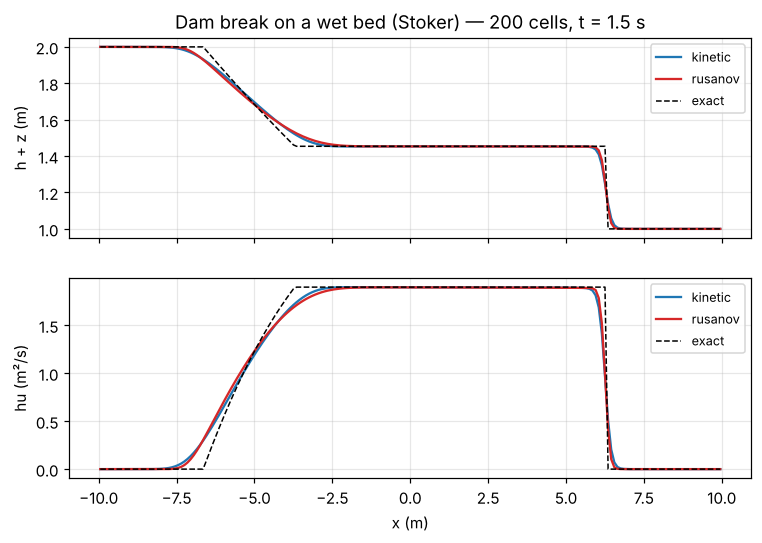
In thirty seconds
make
./build/kinetic-solver --case dam-break-wet --cells 400 --snapshot-every 20
python3 scripts/plot.py output --animate
make test
Where to go next
| Page | What you will find |
|---|---|
| Getting started | Building, running, options, output files, plots |
| Theory | The equations, the kinetic formulation and the scheme of the paper |
| Implementation | How the code is organised and the numerical choices it makes |
| Validation | Exact solutions, convergence, well-balancing, symmetries |
| Contributing | Tests, adding a scheme, a case or an integrator |
| References | Papers the code is based on |
Status
The scheme of the paper is implemented and checked against its definitions to
round-off (see Validation). The code was first written in 2013;
the 2026 revision fixed several bugs (including a truncated value of π that broke
the lake-at-rest property), restructured the code and added a test suite. The
original guide, Guidebook.pdf in the repository, describes the 2013 version.